
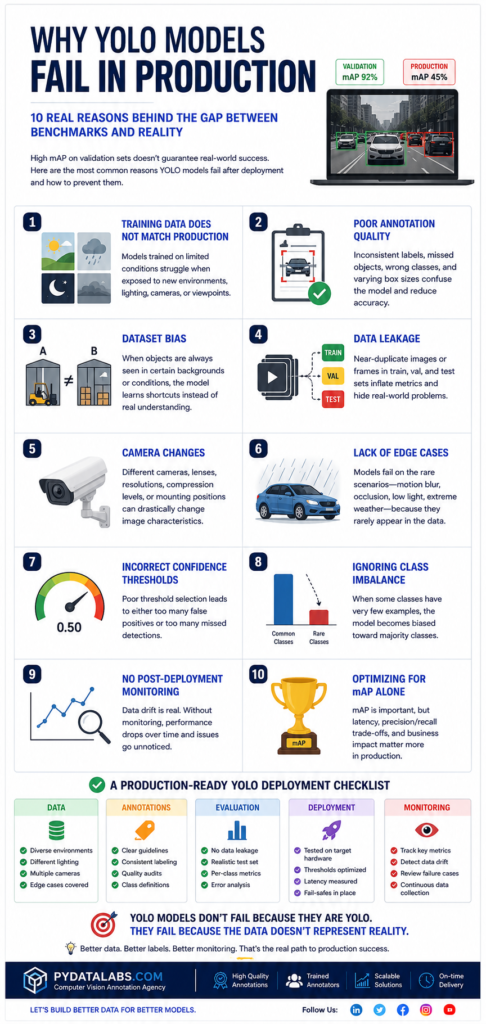
The Hidden Problems That Benchmark Scores Don’t Reveal
A team trains a YOLO model.
Validation mAP: 92%
Stakeholders are excited.
The model gets deployed.
Two weeks later, users complain that detections are being missed, false alarms are increasing, and the system cannot be trusted.
The immediate reaction is usually:
“The model needs more training.”
In reality, the model is often the least important part of the problem.
After reviewing hundreds of computer vision projects across manufacturing, retail, autonomous systems, surveillance, logistics, and agriculture, a pattern emerges:
Most production failures are data failures, deployment failures, or monitoring failures—not architecture failures.
This article explains the most common reasons YOLO models fail in production and how experienced teams prevent them.
Understanding the Difference Between Benchmark Success and Production Success
A benchmark measures:
- Performance on a predefined dataset
- Under predefined conditions
- Using predefined evaluation metrics
Production measures something entirely different:
- New environments
- New lighting
- New cameras
- New object appearances
- New user behavior
- Constantly changing conditions
A model can achieve excellent benchmark results while still being unreliable in real-world operation.
This is not unique to YOLO.
It applies to object detection systems in general.
Failure #1: Training Data Does Not Match Production Data
This is the most common cause of deployment failure.
Imagine a safety helmet detection system.
Training images:
- Bright daylight
- High-resolution cameras
- Clear visibility
- Workers facing the camera
Production environment:
- Dust
- Shadows
- Motion blur
- Night shifts
- Workers partially occluded
The model was never taught these conditions.
It learned:
“What helmets look like in the training dataset.”
Not:
“What helmets look like under all real-world conditions.”
Why This Happens
Teams often collect data during a short project phase.
For example:
- One factory
- One camera
- One week
- One shift
The resulting dataset lacks diversity.
The model becomes specialized for that specific environment.
When conditions change, performance drops.
How to Prevent It
Collect data across:
Time
- Morning
- Afternoon
- Evening
- Night
Weather
- Sunny
- Cloudy
- Rain
- Fog
Hardware
- Different cameras
- Different resolutions
- Different lenses
Locations
- Multiple sites
- Multiple backgrounds
Human Variations
- Different clothing
- Different poses
- Different object appearances
The objective is not more images.
The objective is more diversity.
Failure #2: Poor Annotation Quality
YOLO learns from labels.
If labels are inconsistent, predictions become inconsistent.
Many teams underestimate how damaging annotation issues can be.
Common Annotation Problems
Missing Objects
Annotator labels:
- 4 people
Reality:
- 6 people
The model learns that some visible people should be ignored.
Incorrect Classes
Example:
- Forklift labeled as truck
- Bus labeled as truck
The model receives conflicting information.
Inconsistent Bounding Boxes
Annotator A:
- Tight box around object
Annotator B:
- Large loose box
The model learns contradictory localization patterns.
Occlusion Inconsistency
One annotator labels partially visible objects.
Another ignores them.
The model receives mixed signals.
How to Prevent It
Create detailed annotation guidelines covering:
- Occlusions
- Truncation
- Reflections
- Shadows
- Overlapping objects
- Small objects
Then perform:
- Quality audits
- Consensus reviews
- Random sampling inspections
Annotation consistency is often more important than annotation volume.
Failure #3: Dataset Bias
Models learn patterns present in data.
Unfortunately, they also learn unintended shortcuts.
Example
Suppose every training image containing forklifts comes from:
- Warehouse A
Every image without forklifts comes from:
- Warehouse B
The model may learn:
- Background cues
- Wall colors
- Floor textures
Instead of learning forklifts.
Performance appears excellent during testing.
Production performance collapses.
Signs of Dataset Bias
High validation accuracy combined with:
- Unexpected production failures
- Strange false positives
- Performance variation across locations
Prevention
Ensure:
- Multiple backgrounds
- Multiple environments
- Multiple camera positions
The object should not be strongly associated with a specific scene.
Failure #4: Data Leakage
One of the biggest causes of misleading validation scores.
What Is Data Leakage?
Training and testing contain highly similar images.
Examples:
Frame 1 → Training
Frame 2 → Validation
Frame 3 → Test
These frames are almost identical.
The model effectively sees the same scene repeatedly.
Validation scores become artificially inflated.
Why It Is Dangerous
The model appears excellent.
Deployment reveals the truth.
Performance suddenly drops because real-world scenes are genuinely different.
Prevention
Split data carefully.
Separate by:
- Time
- Camera
- Location
- Video sequence
Not randomly by image.
Failure #5: Camera Changes
A model trained on one camera may struggle on another.
Common Differences
Resolution
Training:
1920×1080
Production:
640×480
Small objects become harder to detect.
Lens Distortion
Different lenses alter object appearance.
Compression
Security systems often use aggressive video compression.
Details disappear.
Mounting Position
Even slight angle changes can alter object visibility.
Prevention
Train using images from the actual deployment hardware whenever possible.
Failure #6: Lack of Edge Cases
Most datasets are dominated by easy examples.
Production failures usually come from rare scenarios.
Examples
Motion Blur
Fast-moving vehicles
Occlusion
Objects partially blocked
Low Light
Night-time operation
Crowded Scenes
Many overlapping objects
Unusual Orientations
Objects viewed from uncommon angles
The Problem
A dataset might contain:
- 95% easy cases
- 5% difficult cases
The model becomes highly optimized for easy cases.
Users experience failures during difficult cases.
Prevention
Track edge cases explicitly.
Create dedicated collections for:
- Night scenes
- Blur
- Reflections
- Weather events
- Occlusions
Failure #7: Incorrect Confidence Thresholds
A technically good model can appear bad because of poor threshold selection.
Example
Threshold = 0.9
Result:
- Very few false positives
- Many missed detections
Threshold = 0.2
Result:
- Few missed detections
- Excessive false alarms
Neither setting may be appropriate.
Best Practice
Optimize thresholds using validation data and business requirements.
Different applications require different tradeoffs.
Examples:
Safety Systems
Prioritize recall.
Missing a detection may be costly.
Automated Actions
Prioritize precision.
False alarms may be expensive.
Failure #8: Ignoring Class Imbalance
Not all classes appear equally often.
Example
Dataset:
- Person: 100,000 instances
- Helmet: 80,000 instances
- Fire extinguisher: 500 instances
The model naturally becomes better at detecting common classes.
Rare classes suffer.
Prevention
Monitor performance separately for each class.
Do not rely solely on overall mAP.
A high overall score can hide severe weaknesses in minority classes.
Failure #9: No Post-Deployment Monitoring
Many teams treat deployment as the finish line.
It is actually the beginning.
Reality
Production environments evolve.
New:
- Equipment
- Packaging
- Clothing
- Vehicles
- Lighting
appear over time.
The data distribution changes.
This phenomenon is known as data drift.
Data Drift
What Happens
Model performance slowly degrades.
Nobody notices until users complain.
Best Practice
Monitor:
- Detection counts
- Confidence distributions
- False positive rates
- False negative rates
- Class distributions
Continuously review production samples.
Failure #10: Optimizing for mAP Alone
mAP is useful.
It is not sufficient.
Example
Two models:
Model A
- mAP: 94%
- Inference: 120 ms
Model B
- mAP: 92%
- Inference: 12 ms
For a real-time application, Model B may be superior.
Production Metrics Matter
Track:
- Latency
- Throughput
- Memory usage
- False positives
- False negatives
- Business impact
The best production model is not always the highest-mAP model.
A Production-Ready YOLO Deployment Checklist
Before deployment, verify:
Data
✅ Diverse environments
✅ Diverse lighting
✅ Diverse cameras
✅ Edge cases represented
Annotations
✅ Consistent guidelines
✅ Quality audits
✅ Class definitions documented
Evaluation
✅ No leakage
✅ Realistic validation set
✅ Per-class metrics reviewed
Deployment
✅ Tested on production hardware
✅ Thresholds optimized
✅ Latency measured
Monitoring
✅ Drift monitoring
✅ Error review process
✅ Continuous data collection
The Key Lesson
Most teams focus on:
- Model architecture
- Hyperparameters
- Training tricks
Experienced teams focus on:
- Data quality
- Data diversity
- Annotation consistency
- Monitoring
Because in production, the difference between a system that works and a system that fails is rarely an extra 1% mAP.
It is whether the model has been exposed to the messy, unpredictable conditions of the real world.
A YOLO model does not fail in production because production is harder than testing. It fails because testing did not accurately represent production.